The shortage of garden seeds this spring gave a foretaste of what it is like when supplies run out. If anything, the shortages demonstrated just how important it is to grow and save your own seeds.
Many gardeners miss the second part of vegetable growing: allowing plants shoot into flower and produce seeds. We’ve been told to have tidy gardens and to pull out our plants as the harvest slows. Nothing could be farther from the truth! As the harvest season slows down, the seeding season is just beginning. The garden is abundant with seeds. We have only to gather and store them to have the most an ample supply we could ever want. read more…
As farms, food vendors, and other businesses begin to reopen, three new scientific studies show why face masks are an important way to bring the COVID-19 coronavirus under control.
COVID-19 has spread so widely because infected people often don’t show symptoms during the first 4–5 days, but still shed virus by breathing, talking or coughing to anyone nearby. read more…
RECIPE
This hearty, seasonal Potato and Leek soup is full of flavour and easy to make. A warming comfort food for a cold day.
If you’re looking to eat more seasonal winter foods, potatoes and leeks are the perfect cold-weather ingredients. Potatoes store well and are easily available in winter. Cold-hardy leeks grow throughout the cooler months, and provide a unique flavour twist on ordinary onions. read more…
Greta Thunberg, outside the Swedish parliament. Her sign reads, “school strike for climate”.
School gardens now have a new role: help prepare young people for climate change. As the global climate warms, the world faces an urgent need for increased food security, sustainability, and environmental stewardship. By instilling kids with skills that support ecological balance, school gardens can be an effective program for meeting the challenge.
It’s clear that climate change is an issue of grave concern to children. In September 2019, millions of young people gathered worldwide to demand action to prevent further global warming. Inspired by Greta Thunberg, a Swedish teenager who began her one-person “school strike for the climate” outside the Swedish parliament in 2018, the protest has grown into an international School Strike for the climate movement of millions. Children want to do something about climate change. When young people work together to grow food and learn sustainable practices, they become part of the climate change solution. read more…
Earlier this year, a group of people showed how quickly ordinary citizens could rewrite laws to protect nature and transition to sustainable farming. It took just four months.
On Salt Spring Island, in Canada’s Pacific maritime climate, oranges and avocados flourish in an innovative, energy-conserving greenhouse. The subtropical fruit greenhouse, called simply “The Garden,” uses renewable energy, thermal mass, nutrient cycling, and rainwater harvesting to grow citrus fruits with minimal inputs. (Article continues below video.)
Video: Growing a Sustainable Citrus Garden in Canada
Ancient grains are making a comeback, as farmers, millers, artisan bakers and diners seek them out for their exceptional flavour, nutrition, and low-gluten content.
The heritage wheat, barley, rye, buckwheat, amaranth, quinoa and flax at Dan Jason’s farm come in many colours. In August, at Salt Spring Seeds, the fields shimmer with blue, gold, and purple seeds and grains. Not the kind you’d see on the large industrial farms of the prairies, but old world varieties that grow today much as they did thousands of years ago. (Article continues below video.)
Beer lovers take note: barley a key ingredient in beer is in trouble around the world.
A recent article in Nature Plants warns that increasing episodes of extreme drought and heat due to climate warming will cause a decrease in world barley production. Today, beer is brewed most commonly from partially germinated (malted) barley. To find out about the effects of climate change on beer, researchers modeled the effects of more frequent droughts and heat waves on 23 barley-growing regions around the world. Under the worst case conditions, barley yields would decrease by 17% and beer prices would double on average.
In bartender speak, low barley supply means less brew to satisfy the world’s surging thirst for this popular beverage. Beer is the third most consumed liquid after water and tea, and the most popular alcoholic drink in the world. So rising costs for this valuable drink will quickly become visible to consumers.
How Beer Got Started
Farming began 10,000 years ago with the domestication of wild wheats and barley. As these grains became the food mainstay, early farmers discovered grain fermentation, and the resulting alcoholic drink we call beer. By the time the pyramids were under construction in ancient Egypt 5,000 years ago, the workers were paid in vegetables, grain, and alcohol. In 2017 the world produced approximately 140 million tons of barley, 20% of which goes for brewing beer.
Although well adapted to a wide range of climates, barley prefers temperate regions such as the northern prairies of North America. Barley does not like extreme heat and drought, which brings us to climate change… read more…
RECIPE
This scalloped potato recipe celebrates the diverse colours and flavours of the much loved, yet humble potato. Red, yellow, blue and white potatoes add colour and nuanced taste to this potato classic. Make with any combination of potato colours and varieties. Topped with cheese, scalloped potatoes are a traditional favourite for special dinners and prepare-ahead entertaining.
Serves 6
Baking time: 1 hour 6 to 8 potatoes of varied colours (red, yellow, blue, white), thinly sliced
1 onion, chopped
1 tbsp olive oil
2 tablespoons flour
2 tablespoons butter
salt
freshly ground black pepper
1 to 1 1/2 cups milk
1/2 cup shredded Cheddar cheese read more…
British Columbia is facing an agricultural crisis. Sixty percent of farmers in BC are over age 55, and the new young generation of farmers cannot take over.
At the same time as baby boom era farmers are retiring, speculation has driven the price of farmland higher than the ability of new farmers to buy it. Unless we find a way to make most of the farmland in the Agricultural Land Reserve affordable, and to grow enough food on it, we can expect to permanently rely on imports to feed ourselves. Two recent projects suggest a way forward for BC.
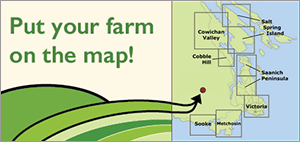
BC Farms & Food is a news & information site about local food and farming in British Columbia. BC Farms & Food is also home to the Vancouver Island Farms & Food Map, a searchable guide to local food.


 A recent article in
  6 to 8 potatoes of varied colours (red, yellow, blue, white), thinly sliced